Asimov Online
Welcome to Asimov Online. Here you'll find a comprehensive collection of resources pertaining to Isaac Asimov (1920-1992), the quintessential author, who in his lifetime wrote over 500 books that enlightened, entertained, and spanned the realm of human knowledge.
The Isaac Asimov FAQ
The FAQ from the Usenet newsgroup alt.books.isaac-asimov provides answers to the frequently asked questions about Isaac Asimov, and is an excellent place to start if you have questions about him. Included is biographical information about both his personal life and his literary life, answers to questions about the Foundation and Robot series, and more.
For a German translation of the FAQ, see Bálint Krizsán's site.
Oh Keen-Eyed Peerer into the Future
"I was dissatisfied. Nixon's resignation preserved his pension and numerous perquisites, and I was not impressed by the argument that it had spared the nation an ordeal. To my way of thinking, the ordeal was necessary to make certain it would never happen again. I felt that by taking the easy way out, we were storing up trouble for ourselves in the future."
-- Isaac Asimov, In Joy Still Felt
Foundation: Three seasons on Apple TV+
The long-awaited adaptation of the Foundation Series, starring Jared Harris as Hari Seldon, Lee Pace as (Brother Day) emperor Cleon, and newcomer Lou Llobell as mathematician Gaal Dornick, premiered on Apple TV+ September 24, 2021. The tenth and final episode of the first season appeared on Nov. 19, 2021. The second season debuted on July 14, 2023, and it's tenth and final episode appeared on September 15, 2023. The first episode of the third season premiered on July 11, 2025, with ten episodes added weekly until Sept. 12, 2025. The series has been renewed for a fourth season, scheduled to begin production in 2026.
Writers from the show talk with host Jason Concepcion and Foundation's showrunner and executive producer David S. Goyer about each episode at Foundation: The Official Podcast.
The Isaac Asimov Centennial Year
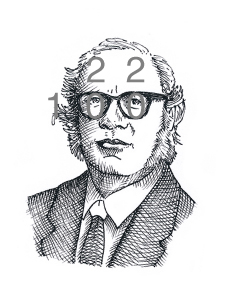 |
January 2, 2020 was the one hundredth anniversary of Isaac Asimov's birth. To belatedly celebrate his centennial year, I hope to update and modernize Asimov Online, which has been neglected for far too long. You can expect new content, including information about all of the editions of his books, a greatly expanded bibliography, with details about all of his fiction and nonfiction essays, and much, much more.
Sheila Williams, editor of Asimov's Science Fiction Magazine, wished Isaac a happy hundredth birthday in an editorial in the January/February 2020 issue.
|
Asimov Recognized by Congress
Isaac Asimov was recognized by the 111th Congress on March 9, 2010 in House Resolution 1055, "supporting the designation of National Robotics Week as an annual event". The following passage appears in the text of the bill:
"Whereas the second week in April each year is designated as 'National Robotics Week', recognizing the accomplishments of Isaac Asimov, who immigrated to America, taught science, wrote science books for children and adults, first used the term robotics, developed the Three Laws of Robotics, and died in April, 1992: Now, therefore, be it resolved..."
The tribute to Asimov is due to the efforts of Paula Brooks, a robotics researcher and long-time fan of his who assisted the committee that wrote the resolution.
Black Widower's Collection: The Return of the Black Widowers
![[The Return of the Black Widowers]](images/trotbw.jpg) |
A new collection of Isaac Asimov's Black Widower mystery stories was published by Carroll & Graf in November 2003. The Return of the Black Widowers features six stories that never appeared in a Black Widowers's collection, plus ten of the best previously collected Black Widower stories. It also includes an introduction by Asimov's close friend, author Harlan Ellison; a pastiche about the Black Widowers; and an essay by Asimov about how he came to write the Black Widowers stories. Also appearing in the collection is a new Black Widowers story, "The Last Story", written by Charles Ardai, the editor of the collection, for the December 2002 issue of Ellery Queen's Mystery Magazine, to commemorate the tenth anniversary of Asimov's death and the thirtieth anniversary of the publication of the first Black Widowers story.
The Return of the Black Widowers can be purchased from amazon.com.
|
Autobiography: It's Been a Good Life
![[It's Been a Good Life]](images/ibagl.jpg) |
In late March, 2002, Prometheus Books published It's Been a Good Life, an autobiography edited by Janet Jeppson Asimov. The book was compiled from selections made from the three previous autobiographical volumes In Memory Yet Green (1979), In Joy Still Felt (1980), and I. Asimov: A Memoir (1994). The book also features "A Way of Thinking", Asimov's 400th essay for the Magazine of Fantasy and Science Fiction, which Janet put together from conversations they had and letters they had exchanged during many years of correspondence. In addition, there are excerpts from those letters sprinkled throughout the book. The result is a portrait of the life of Isaac Asimov, the writer, humanist, thinker, wit, and bon vivant, which lovingly illustrates why he was able to truthfully say "It's been a good life".
The book also includes an epilogue in which Janet Jeppson Asimov reveals for the first time that Isaac's 1992 death from heart and kidney failure was a consequence of AIDS contracted from a transfusion of tainted blood during his December 1983 triple-bypass operation. She explains how and when he learned he had the disease, and why his doctors convinced him to keep it a secret from the public. The epilogue includes a description of Asimov's final days, together with some poignant passages that describe his views of life and death.
[There were some erroneous published reports stating that it was Janet Asimov who convinced her husband to keep the fact that he had contracted AIDS a secret. This is absolutely untrue. In fact it was Asimov's doctors who urged that the matter be kept a secret. See Janet's April 4, 2002 letter to Locus magazine.]
The book can be purchased online from Amazon or Barnes and Noble.
|
Lists of Asimov's Works
- A catalogue of Asimov book titles, arranged by categories in the same fashion as in his autobiographies. (55k)
- A list of Asimov's book titles, numbered in order of authorship, as known or estimated. (54k)
- A "big list" of all known editions [that is, known by the list compiler, Ed Seiler] of Asimov's books, in order of publication. This includes title, publisher, year of publication, number of pages, size, Library of Congress call number, Dewey number, ISBN, and Library of Congress card catalog number. (183k)
Note: This file has been formatted for 132 columns.
- The "big list" in alphabetical order by title. (183k)
Note: This file has been formatted for 132 columns.
- A guide to Asimov's short fiction. Every short story Asimov ever wrote is listed here. Indexes are provided that list works in each genre in order of publication, and an alphabetical index of titles lets you find an entry for any Asimov story title. Entries for each story cite where the story was first published, and list Asimov's collections and the anthologies in which the story appears. (77k)
- A guide to Asimov's essays. Over 1600 of Asimov's essays are listed here, including the subject of the essay, the publication in which the essay first appeared, and a list of Asimov's collections in which the essay appeared. Indexes list the essays chronologically for each major series (e.g. the science essays in the Magazine of Fantasy and Science Fiction), and also group the essays by subject, in order to help you find any essay Asimov wrote on any given subject. (151k)
- A list of books and articles about Asimov. (6k)
- Johnny Pez's Insanely Complete Robot/Foundation Fiction List
A chronology of events in Isaac Asimov's positronic robot and Foundation stories, compiled by Johnny Pez.
- A list of worlds mentioned in the Foundation series. (5k)
- A list of Asimov works available on other media: records, audio tapes, videotapes, computer software, and board games. (14k)
Sources for Obtaining Asimov's Books
There are many websites that offer books for sale, and of course the number grows each day. A number of those are good sources for books by Asimov, and a few are listed here. Please note that the listing of these sites do not constitute an endorsement of their services.
- Amazon: With millions of titles available, there is a good chance that you can find most of Asimov's books that are currently in print at Amazon.
- The Advanced Book Exchange represents large numbers of independent used book dealers, and is a good source for hard-to-find books.
- The Antiquarian Booksellers' Association of America offers out-of-print, collectible, and hard to find books. They are an association of booksellers who collectively sell books on the Internet. . Their selection of books by Asimov often includes a number of titles you may not have seen elsewhere.
- Powell's Book Store is a large store in Oregon (reputed to be the largest bookstore west of the Mississippi) that has a website.
- And last, but not least, don't forget your local library as a source for borrowing books for reading.
Publishers of Asimov's Books on the Web
- Prometheus Books published several of Asimov's essay collections.
- Random House, which publishes most of Asimov's science fiction titles that are currently in print.
- Gareth Stevens Publishing has published 50 of Asimov's books for young people on science, technology, and explorers.
- HarperCollins, published several of the more recent titles.
- HarperCollins UK, whose Voyager imprint includes a substantial number of Asimov's books published in the UK.
- Tor Books published hardcover editions of Asimov's science fiction novels that are still available as trade paperbacks. Their website provides information about their science fiction and fantasy books, and has links to other SF resources on the web.
Reviews
- Jenkins' Spoiler-Laden Guide to Isaac Asimov is a collection of the late John H. Jenkins' reviews of every one of Isaac Asimov's books. John offers his views of what he likes and dislikes in Asimov's books from the point of view of a dedicated Asimov enthusiast, and provides a graphical rating system that neatly summarizes his evaluations for both the Asimov fan and the intended audience of each book. He has included reviews of Asimov's short fiction. John's opinions are highly personal, comprehensive, and clearly written, and definitely worth a look. He also has a blog of "random thoughts on one of the world's most prolific authors".
- Search the science fiction review archives of the Science Fiction Resource Guide to view their collection of reviews of Asimov's books.
A Graph of Asimov's Book Publications
It took nineteen years for Asimov to publish his first 100 books, ten years to publish the next 100, and only five years to bring the total up to 300. Thanks to Tony Neilson, here is a graph of the number of books Asimov published each year throughout his career: ![[Graph image]](oldsite/gifs/pub_graph_small.gif)
Some Items of Interest
Isaac Asimov's Birthplace
Isaac Asimov was born in Petrovichi, Russia, in 1920. Petrovichi is very proud of their native son, and have honored the place of his birth with a memorial stone. A picture was supplied by Alexander Azimov, who is almost certainly a relative of Isaac's.
Essays by Johnny Pez
Johnny Pez dispenses his knowledge in a series of essays:
The publishing history of the Positronic Robot and Foundation stories:
The publishing history of the Positronic Robot and Empire novels, 1947-1958
The Rise and Fall of the Spacers
Articles from the Encyclopedia Galactica:
A Piece of History
By March 18, 1941, Isaac Asimov had written thirty-one stories, sold seventeen, and fourteen had been published. At that time, he considered himself nothing more than a third-rate writer. That evening, he sat down to write his thirty-second story, based on an idea suggested by Astounding editor John W. Campbell the day before. By April 8, he finished the story, titled "Nightfall", and on April 9 he took it to Campbell. Two days later, he received this letter from Campbell, and the history of science fiction was changed forever.
Cosmic Corkscrew
Science Fiction writer Michael A. Burstein pays homage to Isaac in Cosmic Corkscrew, his Hugo Award nominated story which appeared in the June 1998 issue of Analog, and honors the 60th anniversary of Asimov's submission of his first story to Astounding Science Fiction.
Asimov and Religion
Mike Brummond's scholarly essay Religion in Asimov's Writings considers the aspects of religion that appear in Asimov's fiction, and Asimov's views on religion, as expressed in his nonfiction.
Asimov's Science Fiction Magazine
Asimov's Science Fiction Magazine has a website containing feature articles, excerpts from upcoming issues, book reviews, online interviews, reprints of Isaac Asimov's editorials, and much more.
The Magazine of Fantasy & Science Fiction
Home to Isaac Asimov's monthly science column for over thirty-three years, The Magazine of Fantasy & Science Fiction, founded in 1949, is the award-winning SF magazine which is the original publisher of SF classics like Stephen King's Dark Tower, Daniel Keyes's "Flowers for Algernon" and Walter M. Miller's A Canticle for Leibowitz. The website has selections from recent and upcoming issues, current issue contents, writer's guidelines, and subscription information.
Other Asimov Resources
- The Encyclopedia Galactica is the ultimate reference work for the universe detailed in Isaac Asimov's robot, Galactic Empire, and Foundation stories. Providing information on people, chronology, robotics, and other topics, it is published by the Encyclopedia Galactic Publishing Co., via the efforts of Mike Carlin of Bristol, England.
- In the early sixties, Asimov regularly contributed book reviews to The Horn Book, a children's literary review journal, who marked their 75th anniversary in October 1999. At their virtual history exhibit is a letter from Asimov to an editor at Horn Book, after he received an unexpectedly large payment, asking to make sure that he wasn't overpaid.
- On September 25, 1987, Asimov was interviewed by Terry Gross for the National Public Radio program Fresh Air. A 27-minute interview can be found at the Fresh Air archive.
- The Life & Times section of the New York Times website also features articles by and about Asimov, as well as reviews of Asimov's books that appeared in the Times (registration required).
- Science Fiction writer Michael A. Burstein, winner of the 1997 John Campbell Award for Best New Writer, remembers Isaac Asimov in "Asimov and Me", first published in the Fanzine Mimosa in December 1997.
- A 1988 interview with Asimov by Slawek Wojtowicz, a science fiction fan from Poland.
- The transcript of a lecture by Asimov on the future of humanity.
- An obituary for Isaac that appeared in Newsday.
- A
chronology of Asimov's Susan Calvin stories, robot novels, galactic
empire novels and Foundation series.
- An essay by Robert J. Sawyer on why the Three Laws of Robotics aren't used in the real world.
A Few Science Fiction Resources
Author:
Edward Seiler

![[Graph image]](oldsite/gifs/pub_graph.gif)